


Estimated time to read: 5 minutes If you’re working in a Finance team you will have seen AI-powered...
AI Automation Without Governance Is Just Faster Risk
Time to read: 10 mins
For many Finance leaders, the conversation has changed. The question is no longer whether AI has a place in Finance, it's where it should be introduced, which processes should be automated, and how quickly the benefits can be realised.
There is good reason for enthusiasm as AI can accelerate month end close, improve forecasting, automate reconciliations, process invoices, identify anomalies, and produce management commentary in seconds rather than hours.
But there is another question that deserves just as much attention.
Who is governing the AI?
Without governance, AI doesn't just automate work. It automates mistakes, inconsistencies and poor decisions at a speed that manual processes never could.
The organisations that achieve the greatest success with AI won't necessarily be those using the most advanced models, they'll be the ones that ensure every automated decision follows the same controls, policies and approval processes that their finance teams already use and rely on.
Finance Already Has Governance
Finance has always operated within strict controls.
-
Every payment follows approval rules.
-
Every journal requires authorisation.
-
Every purchase has policies.
-
Every financial statement is reviewed before publication.
These controls exist because Finance isn't simply about processing transactions; it's also about protecting the business. Introducing AI should strengthen these safeguards, not remove them.
If an AI agent can approve supplier invoices, prepare journals or trigger payments without following established controls, the technology has become a risk rather than an asset.
You wouldn’t let a new hire, however experienced they are, get to work without understanding your processes and rules. It’s the same with AI, it should fit into your governance framework, not replace it.
Business Rules Must Come Before Automation
One of the biggest misconceptions surrounding AI is that it can simply "figure things out".
Large language models are excellent at understanding language and identifying patterns, but they don't know your organisation's finance policies.
They don't know:
-
Which invoices require two levels of approval.
-
Which suppliers require additional compliance checks.
-
Which journals need Finance Manager sign off.
-
Which cost centres have spending restrictions.
-
Which customers have bespoke billing rules.
Those decisions come from your business.
Before any process is automated, these rules need to be documented, agreed and built into the workflow. AI shouldn’t be deciding what your policies are, it should be following them consistently.
Human Validation Should Remain Part of the Process
One of the most common fears surrounding AI is that organisations will remove people from financial decision making.
Successful AI automation actually does the opposite by allowing people to focus their attention where their judgement is required.
Routine, repetitive tasks can often be automated with confidence, but higher risk activities should include human validation before action is taken.
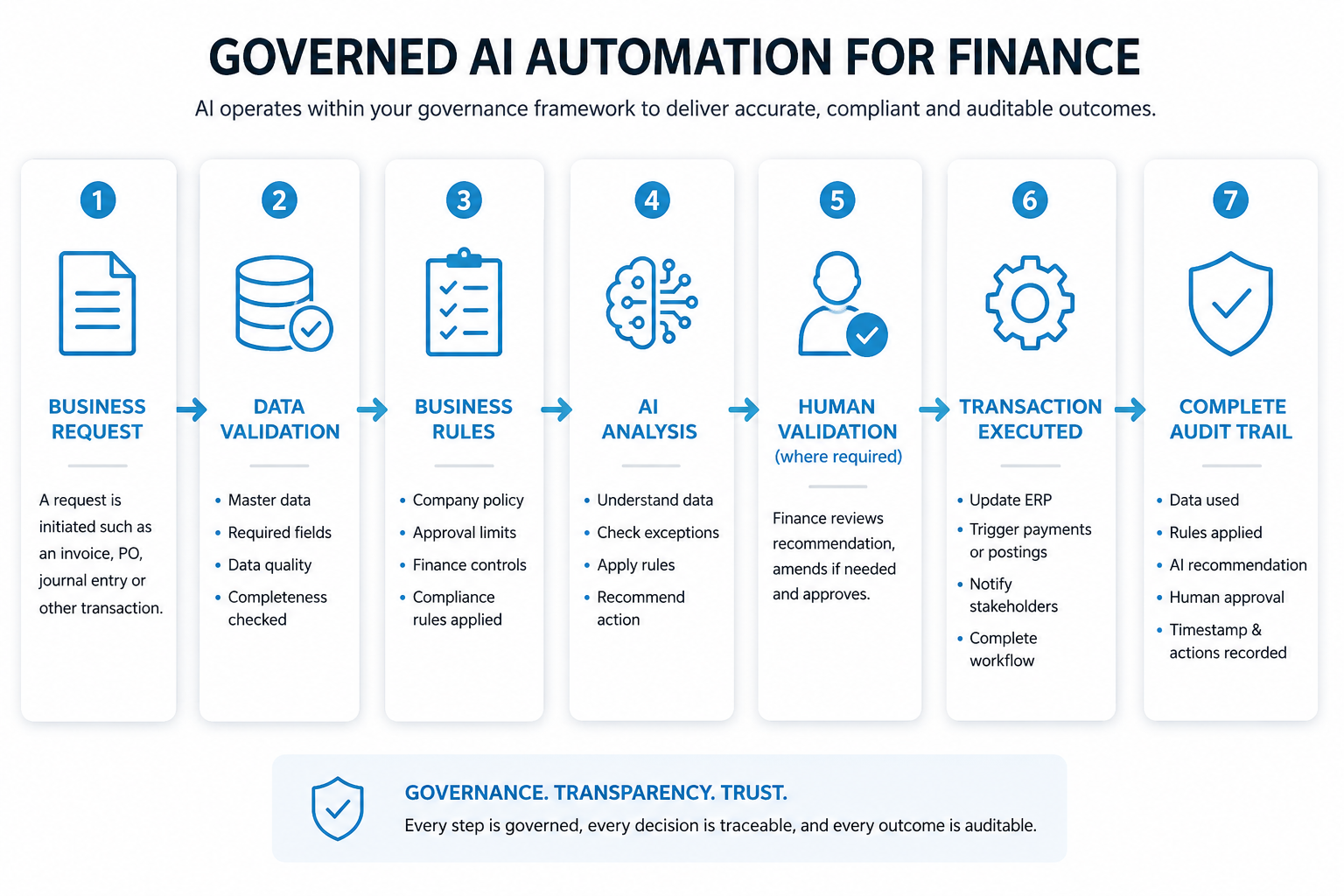
If AI was a new hire you should think of it as a highly capable analyst. It can gather information, perform calculations, identify exceptions and recommend an action. The final decision, where appropriate, should still sit with someone who understands the commercial context.
For example:
-
AI identifies invoices ready for payment.
-
AI validates them against purchase orders.
-
AI checks supplier history.
-
AI confirms approval thresholds.
-
Finance reviews any exceptions.
-
A manager provides final approval before payment is released.
The result is faster processing without sacrificing control.
Not Every Process Needs the Same Level of Oversight
Governance shouldn't become a barrier to automation, but you should match controls to risk.
-
Low value, repetitive activities may be automated with little intervention.
-
Higher value or more sensitive processes should include additional validation.
For example:
Low Risk
-
Expense categorisation
-
Report generation
-
Data cleansing
-
Routine reconciliations
Medium Risk
-
Purchase order matching
-
Invoice coding
-
Budget variance explanations
-
Supplier onboarding checks
Higher Risk
-
Payment approvals
-
Journal postings
-
Credit limit changes
-
Customer refunds
-
Financial reporting
-
Regulatory submissions
This doesn’t mean that every workflow requires manual approval, but each should have appropriate governance.
Audit Trails Matter More Than Ever
One of Finance's greatest strengths has always been traceability.
You can usually answer questions such as:
-
Who approved this?
-
When was it changed?
-
Why was the decision made?
The same standard should apply to AI.
-
Every automated action should be recorded.
-
Every recommendation should be traceable.
-
Every approval should be auditable.
If an external auditor asks how a payment was authorised or why a journal was posted, you cannot simply say:
"The AI decided."
Instead, you should be able to demonstrate:
-
The data the AI used.
-
The business rules it applied.
-
The validation completed.
-
The individual who approved the outcome.
-
The actions taken.
Having good governance creates confidence, both internally and externally.
Governance Is Also About Data
Even if you have perfectly governed AI, it can fail if it works with inaccurate or inconsistent information.
You should ask:
-
Is our master data accurate?
-
Are business definitions consistent?
-
Can different systems produce conflicting answers?
-
Are we relying on spreadsheets outside governed processes?
-
Does everyone use the same version of financial truth?
This is one reason many AI projects fail to deliver the expected return. The technology works but the data underneath it doesn't.
Preparing your finance data is often the most valuable investment you can make before introducing AI automation.
Questions You Should Ask Before Scaling AI
Before introducing AI into core finance processes, ask:
-
Have we documented the business rules the AI must follow?
-
Where should human approval remain mandatory?
-
Which processes carry the greatest financial or regulatory risk?
-
Can every automated action be audited?
-
Is our finance data accurate enough for AI to rely on?
-
Who owns the governance of AI across Finance and IT?
-
How will we monitor performance and refine workflows over time?
These questions often determine whether AI becomes a trusted member of the finance function or another technology that creates more work than it removes.
Governance Enables Confidence
AI has enormous potential to improve finance operations.
It can reduce manual effort, increase consistency and free your finance team to focus on analysis rather than administration.
But automation without governance simply increases the speed at which poor decisions can spread through an organisation.
The organisations we speak to that see the strongest results aren't replacing governance with AI, they're embedding it into every automated workflow.
At Positive8, we believe successful AI automation starts long before the first workflow is deployed. It begins with trusted data, clearly defined business rules, strong governance and processes that balance automation with appropriate human oversight.
When you have those foundations in place, AI will become more than a productivity tool, it will become a trusted extension of your finance team.
-2.png?width=1000&height=265&name=Positive8%20Blog%20Contact%20Us%20(1000px%20x%20265px)-2.png)